.png)
2025 TRIAL HIGHER SCHOOL CERTIFICATE EXAMINATION
Enterprise Computing
Morning Session
Friday, 15 August 2025
General Instructions
• Reading time – 10 minutes
• Working time – 2 hours and 20 minutes
• You must use wired headphones while viewing video content.
• The word count that is indicated for each question provides a guide to the expected length of response.
EXAMINERS
Benjamin Lum (Convenor) | The King’s School, North Parramatta |
Total marks: 80
• Attempt Questions 1-25
• Allow 2 hours and 20 minutes to attempt the questions
Question 1 (1 mark)
When utilising the iterative approach in Enterprise Computing, what typically happens after each iteration?
Question 2 (1 mark)
Which of the following is the key difference between quantitative and qualitative data?
Question 3 (1 mark)
Which of the following best describes the purpose of data visualisation?
(Multiple items may be selected.)
Question 4 (1 mark)
In a chemical plant, an expert system monitors temperature, pressure, and chemical flow. It adjusts settings in real time to keep the process running efficiently and prevent failures.
What is the main purpose of the expert system in this scenario?
Question 5 (1 mark)
Which of the following best describes how blockchain technology is used to manage and verify data?
Question 6 (1 mark)
Which of the following features of software is the most important in ensuring the privacy and security of data?
Question 7 (1 mark)
Which of the following is an example of an unstructured data set?
Question 8 (1 mark)
Which of the following innovative technologies have impacted the field of data analytics?
(Multiple items may be selected.)
Question 9 (1 mark)
An expert system is designed to diagnose a medical condition based on symptoms. The system uses the following certainty factors (CF) for two symptoms:
1. Symptom One: Fever (CF = 0.9)
2. Symptom Two: Cough (CF = 0.6)
The expert system then checks a final symptom:
3. Symptom Three: Body ache (CF = 0.7)
Which of the following is the most appropriate next step for the expert system to construct its decision tree, based on certainty factors?
Question 10 (2 marks)
Match the following tools with the correct characteristic.
| Decision tree | Gantt chart | Implementation plan | System flowchart | |
|---|---|---|---|---|
| Displays dependencies and resource allocations | ||||
| Visual representations of how data is processed within a system | ||||
| Organises data into a series of choices and their possible outcomes | ||||
| Describes how staff will be trained to use the new enterprise system |
Question 11 (2 marks)
The school has introduced an online ticketing app to make it easier for students to book and pay for tickets to school drama and band performances. Students use the app to browse available performances and book tickets. After selecting the tickets, they make payments directly through the app to the bank. Once the payment is processed, they receive a confirmation email with their ticket(s).
Complete the following Level 0 data flow diagram to represent this system.
Question 12 (3 marks)
A teacher has set up a spreadsheet to calculate the average mark for each student based on their results from the three tasks completed during the course. This average mark is then used to calculate a course grade using the Grade Table. It then checks the grade and if the student has received an A for the course, they will be receiving an award at the end-of-course presentations night.
Formulae are needed for:
- Cell E3 to calculate the average of the three tasks in cells B3, B4 and B5. This formula will be used to fill down to cells E4 to E7. (1 mark)
- Cell F3 to display the grade achieved, based on the lookup table that is located in cells A12:B16. This formula will be used to fill down to cells F4 to F7. (1 mark)
- Cell G3 to determine whether the student will be receiving an award if they have achieved an A grade. It will display “Yes” for receiving an award, or “No” for not receiving an award. This formula will be used to fill down to cells G4 to G7. (1 mark)
Question 13 (4 marks)
A medical centre has decided to implement a new appointment management system to replace their paper-based appointment book.
Stimulus for Question 13(b)
The following shows an extract of the information stored in the system’s Patient table:
| PatientID | PatientFirstName | PatientLastName | PatientDOB |
| ALM001 | Ally | MacDonald | 2007-01-01 |
| COB001 | Colin | Bird | 2019-02-28 |
| OZB001 | Oz | Barram | 1979-12-08 |
| MIL001 | Michelle | Lena | 1985-05-05 |
| HFO001 | Hayley | Foxglove | 2009-09-15 |
| JMO001 | Jim | Moss | 2006-08-31 |
Add the appropriate fields into each of the tables to show a correctly normalised schema. Use (P) to indicate primary key and (F) to indicate foreign key. The fields for Patient table have been included for you. (2 marks)
| Doctor | Appointment | Patient | ||
.svg)
|
.svg)
|
PatientID (P) | ||
| PatientFirstName | ||||
| PatientLastName | ||||
| PatientDOB | ||||
Construct an SQL statement to identify the patients who are born on or after 2007-01-01. List the first and last names of the patients as well as their date of birth in chronological ascending order of their date of birth. (2 marks)
Question 14 (2 marks)
Describe the role of the inference engine in an expert system.
Question 15 (3 marks)
Explain how prototypes can be used to inform the requirements and limitations of an enterprise system. Provide an example in your response.
Question 16 (4 marks)
A local sports club is updating the system that manages its membership. They want to employ a specialist software development company to design a working model of the updated system.
Recommend a combination of development approaches for the proposed system and justify your choice.
Question 17 (6 marks)
ShopSmart is a global e-commerce company that collects vast amounts of data from its customers. The data includes purchase history, user behaviour on the website, customer feedback, product reviews, and location data. ShopSmart has been expanding rapidly and operates in multiple regions, leading to an increasing amount of data being generated daily. The company aims to utilise this data to improve customer experience, optimise inventory, predict trends, and personalise product recommendations.
To manage this growing volume of data, ShopSmart has implemented a data warehousing solution that consolidates data from multiple sources into a central repository. The company also uses advanced simulation and data modelling tools to predict future sales trends and to optimise its supply chain operations. Additionally, the company has automated its inventory management system to ensure timely stock replenishment based on the predicted demand.
Outline the use of big data and data warehousing in ShopSmart’s operations. In your response, you should consider volume, variety, and velocity. (3 marks)
Explain the application of data modelling and the automation of systems in ShopSmart’s operations. (3 marks)
Question 18 (4 marks)
A medical expert system can use a flowchart to determine possible causes of a fever based on symptoms. The system follows the following IF-THEN rules to guide decision-making:
- IF the patient has a fever → THEN check for a sore throat.
- IF the patient has a sore throat → THEN check for white spots in the throat.
- IF white spots are present → THEN diagnose strep throat and recommend a doctor visit.
- IF no white spots → THEN diagnose flu and suggest rest and fluids.
- IF no sore throat but a runny nose and sneezing → THEN diagnose common cold and recommend home care
- IF no sore throat and no runny nose and sneezing → THEN run further tests
Create a flowchart to represent a decision-making process using IF-THEN rules in the medical expert system.
Question 19 (4 marks)
A company has implemented a new customer relationship management (CRM) system.
During the testing and evaluation phase, the project team must verify and validate the system to ensure it is effective and reliable.
Explain, using examples, the methods the project team can use to verify and validate the CRM system.
Question 20 (6 marks)
A book shop tracks its monthly sales performance using spreadsheet software. The dataset below records sales revenue, expenses, profit, units sold, and customer satisfaction across different regions and products over three months. The company relies on this data to identify trends and improve decision-making.
Please refer to the following sample spreadsheet to answer Question 20.
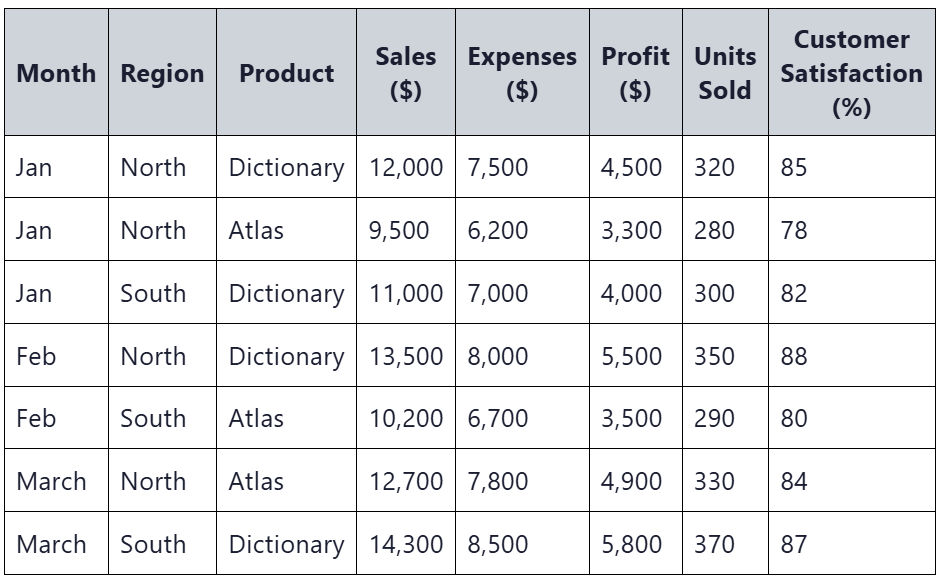
Using the book shop’s spreadsheet, create two different visual representations of key trends in the data that would be displayed in a data dashboard.
Ensure your visualisations are clear and effectively communicate insights. (3 marks)
The book shop operates a large online store that collects vast amounts of customer data, including browsing history and purchases. It uses machine learning to recommend products and real-time tracking to offer instant discounts. Some users worry about how their data is stored and whether their digital footprint is used ethically.
Describe the impact of data scale for the book shop. In your response, consider at least two of the following aspects: volume, storage, real-time streaming, changes in human behaviour, or ethical implications. (3 marks)
Question 21 (7 marks)
HealthPlus, a healthcare provider, is adopting an enterprise computing system to manage patient records, appointments, and medical histories. The system will integrate data from various sources, including electronic health records (EHR), wearable devices, and lab results. HealthPlus plans to use machine learning and statistical modelling to analyse big data for predicting patient outcomes, identifying trends, and improving treatment plans.
The implementation plan involves ensuring data privacy and compliance with legal regulations, as well as training staff to use the new system effectively.
HealthPlus would like to first implement the new system in one of its clinics to evaluate the new system before rolling it out to all its clinic locations.
Which method of implementation is being proposed? (1 mark)
Explain the role of intelligent systems in surveillance within the HealthPlus system. (3 marks)
Explain how machine learning and statistical modelling are used in the HealthPlus system to analyse big data. (3 marks)
Question 22 (6 marks)
A large city museum uses advanced technologies to enhance its operations and visitor experience. The museum employs online analytical processing (OLAP) to analyse visitor data and uses intelligent systems incorporating virtual reality (VR) and touch and gesture interfaces in its interactive exhibits.
Explain how OLAP can be used to analyse visitor data in this museum. (3 marks)
Explain the role of TWO hardware components used in the museum’s intelligent system. (3 marks)
Question 23 (6 marks)
A data scientist is undertaking a project that analyses player statistics from a local football app used for game and team management. The data visualisations will be used to predict future representative players.
Describe TWO strategies to be used by the data scientist to maintain data quality and data security when developing the football club data visualisations. (3 marks)
The data scientist needs to work together with a group of officials and representatives within the football league to refine the data visualisations being produced in this project.
Describe TWO online communication systems that allows sharing and collaboration by allowing this group to work remotely together in real-time. (3 marks)
Question 24 (4 marks)
A large e-commerce company collects personal data from millions of users, including their purchasing habits, location, and browsing history. The company uses this data to create personalised advertisements and optimise its services. However, concerns have been raised about the privacy of users, the ethical implications of data collection, and the environmental impact of maintaining large-scale data centres.
Explain the social, ethical, and legal implications of this company using personal data for personalised advertisements and service optimisation. In your answer, show the impact on individuals, society, and the environment.
Question 25 (8 marks)
A healthcare organisation is developing a data visualisation tool to track patient recovery rates from various treatments. The tool aggregates patient data from electronic health records (EHRs), surveys, and follow-up assessments. However, the data collection process is focused primarily on patients from urban hospitals, with limited data from rural or remote healthcare facilities.
Explain how bias in data collection, storage, and analysis could impact the development of the healthcare data visualisation tool and how these issues could be addressed.